


The Future of Intra-African Trade: From Continental Ambition to Economic Integration
Africa’s next major trade opportunity may not lie beyond its borders, but within them. As the AfCFTA takes shape, digital payments expand and African businesses build regional supply chains
 chijioke
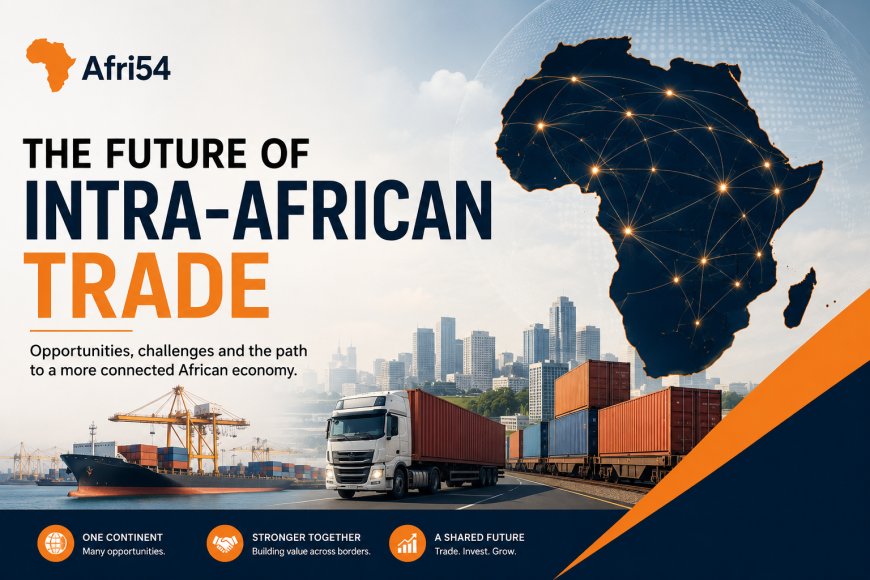


Africa’s next major trade opportunity may not lie beyond its borders, but within them. As the AfCFTA takes shape, digital payments expand and African businesses build regional supply chains, build regional supply chains, the continent is moving towards a more integrated market. But turning that potential into sustained trade growth will require more than agreements—it will require infrastructure, finance, industrial capacity and a fundamental shift in how Africa does business.
For much of the modern era, Africa’s position in global trade has been defined by an uncomfortable contradiction. The continent possesses some of the world’s largest reserves of critical minerals, vast agricultural resources, a rapidly expanding consumer market and a young population, yet many of its economies remain heavily dependent on trading with markets outside the continent.
Raw materials leave African shores. Finished products return.
That pattern has generated export revenues, but it has also limited the amount of value created and retained within African economies. It is one reason the question of intra-African trade has become increasingly important—not simply as a matter of regional cooperation, but as a central part of the continent’s industrial and economic strategy.
There are signs that the landscape is changing.


According to Afreximbank’s African Trade Report 2025, trade between African countries increased by 12.4% in 2024 to US$220.3 billion, following a contraction of 5.9% in 2023. Over the same period, Africa’s total merchandise trade recovered by 13.9%, reaching approximately US$1.5 trillion.
The numbers matter. But what matters more is what happens next.
The central question is no longer whether Africa has the potential to trade more with itself. It clearly does. The question is whether the continent can build the systems, industries and financial infrastructure required to make intra-African trade commercially competitive at scale.
A Market Larger Than Borders
The African Continental Free Trade Area (AfCFTA) represents the most ambitious attempt yet to address that challenge.
Its significance lies not merely in reducing tariffs. The deeper proposition is the creation of a continental market in which businesses can increasingly treat Africa as a connected commercial space rather than a collection of isolated national economies.


That distinction is important.
For a manufacturer, a larger market can justify investment in production capacity that would not be commercially viable if the business were limited to one country. For an agricultural processor, access to regional consumers can create incentives to move beyond exporting raw commodities. For technology companies, financial institutions and professional-service providers, continental reach can create entirely new categories of demand.
The economic logic is straightforward: scale changes what businesses are willing and able to build.
But market size alone does not create integration. Businesses need to be able to move goods, money, information and services across borders at reasonable cost.
That is where the real test of AfCFTA begins.
The Industrial Question
Africa's trade future cannot be separated from its industrial future.
For decades, the continent's participation in global trade has been concentrated disproportionately in commodities. This has left many countries vulnerable to fluctuations in global commodity prices while limiting opportunities to capture greater value through processing and manufacturing.
A more integrated African market creates an opportunity to change that equation.
Consider agriculture. Rather than exporting cocoa, cotton, coffee or other commodities primarily as raw materials, African economies can develop interconnected systems in which crops are processed, packaged, branded and distributed within the continent.
The same principle applies to minerals.
The objective should not simply be to extract critical minerals and export them. The larger opportunity is to develop industries around processing, components, manufacturing and related services wherever commercially viable.
This is what makes intra-African trade strategically important. It can provide the demand base required for African industries to move further up the value chain.
Afreximbank's 2025 trade report makes the case for this shift clearly: despite the recovery in African trade, the continent accounted for only about 3.3% of global exports, reinforcing the need for greater industrialisation and diversification.
The objective, therefore, should not be simply to trade more.
It should be to produce more, process more and retain more value within Africa.
The Payment Infrastructure Behind the Trade
There is little value in opening a market if businesses cannot efficiently receive payment from it.
Cross-border payments have historically been one of the less visible but more consequential obstacles to intra-African commerce. Businesses operating across multiple African markets often contend with fragmented banking systems, foreign-exchange constraints, correspondent banking arrangements and currency-conversion costs.
This is why payment infrastructure has become an important part of Africa's trade agenda.
The Pan-African Payment and Settlement System, or PAPSS, is designed to allow participating banks and payment institutions to facilitate cross-border transactions using African currencies, reducing the dependence on intermediary currencies and systems.
The significance extends beyond convenience.
For large corporations, payment friction may be a manageable cost of doing business. For a small or medium-sized enterprise, it can determine whether a cross-border transaction is commercially viable at all.
The African Development Bank's latest trade-finance research illustrates the broader challenge. Its 2026 report estimates that unmet demand for trade finance in Africa stood between US$74 billion and US$92 billion in 2024. Foreign-exchange liquidity was identified by 36% of surveyed banks as their primary constraint on expanding trade finance, compared with 18% during 2015–2019.
This is not a minor technical issue.
If African businesses are expected to trade more with one another, the financial system must be capable of supporting that trade.
Digital Trade Is Becoming Part of the Infrastructure
The next generation of intra-African trade will also be significantly more digital.
The growth of e-commerce, fintech, cloud services, digital platforms and remote professional services is changing what it means to trade across a border. A business no longer needs to establish a physical office in another country before it can begin reaching customers there.
But digital commerce creates its own regulatory questions.
How should data move across borders? How should digital contracts be recognised? What standards should govern online transactions? How can consumers and businesses be protected without creating unnecessary barriers to innovation?
The African Union's AfCFTA Protocol on Digital Trade is intended to address precisely these issues. The protocol establishes common principles and rules designed to facilitate digital trade, improve interoperability between systems and create a more predictable continental digital environment.
This is potentially transformative for African SMEs.
A fashion label in Lagos, a software company in Nairobi, a consulting firm in Accra or a creative business in Johannesburg can increasingly find customers beyond its domestic market without the physical infrastructure traditionally associated with international expansion.
But digital trade will only reach its potential if the underlying systems are interoperable.
Africa does not need 54 disconnected digital economies.
It needs digital systems that can communicate with one another.
Infrastructure Will Decide Whether Integration Is Real
There is an obvious physical dimension to this conversation.
Goods still have to move.
And in many parts of Africa, moving goods between neighbouring countries remains considerably more complicated than the existence of a trade agreement would suggest.
Poor road and rail connectivity, congestion at ports, inefficient border procedures, inconsistent customs systems and high logistics costs can erase the commercial advantages created by tariff reductions.
This is why infrastructure should be viewed as part of trade policy rather than as a separate development issue.
A manufacturer cannot benefit from access to a regional market if transporting its products there makes them uncompetitive.
A farmer cannot take advantage of regional demand if produce spoils before reaching the border.
A retailer cannot build a continental distribution network if supply chains remain unreliable.
The African Development Bank has increasingly positioned trade corridors and regional infrastructure as essential components of continental integration. The logic is difficult to dispute: Africa's markets can only become meaningfully connected when the physical networks linking producers, ports and consumers are capable of supporting the volume of trade those markets generate.
The challenge, however, is not simply to build more roads or ports.
It is to build connected infrastructure around economic corridors.
SMEs Will Be Central to the Next Phase
The success of intra-African trade should not be measured only by the expansion of large corporations.
Small and medium-sized enterprises will be equally important.
Across Africa, SMEs dominate the business landscape. They are also among the businesses most constrained by limited access to finance, market information, logistics and formal cross-border trade systems.
The latest African Development Bank trade-finance report highlights this gap. Commercial banks intermediated an average of only 23% of Africa's total trade between 2020 and 2024, down from 40% during 2011–2019. At the same time, intra-African trade represented 34% of bank-intermediated trade during the period—an 89% increase over pre-pandemic levels.
That combination tells an important story.
There is demand for African trade, but the financial system is not yet serving the market at the level required.
For SMEs, the solution will need to extend beyond conventional bank lending. Trade guarantees, alternative credit assessment, digital finance, supply-chain finance and stronger regional financial institutions will become increasingly important.
If Africa wants its businesses to scale across borders, it must make it possible for smaller businesses to finance that expansion.
From National Markets to Regional Value Chains
One of the most consequential changes in the next decade may be a shift in how African companies think about production.
For too long, the default question has been: How can we manufacture this product locally?
Increasingly, the better question may be: Where across Africa can each stage of this value chain be performed most efficiently?
That could lead to more specialised regional production.
One country may provide agricultural inputs. Another may process them. Another may manufacture packaging or components. Logistics companies may connect the different stages, while financial institutions provide working capital and payment infrastructure.
The result would be a production ecosystem that is African in scope without requiring every country to produce everything.
This is the difference between simply increasing trade volumes and developing an integrated economy.
A mature continental market does not mean that every country becomes self-sufficient.
It means countries become more economically interdependent in productive ways.
The Hard Part: Implementation
The vision is compelling. Implementation is where the difficulty lies.
AfCFTA can establish rules, but businesses still encounter practical barriers at borders.
Digital trade protocols can create common principles, but governments still need to implement compatible systems.
Payment infrastructure can reduce transaction friction, but businesses still need access to foreign-exchange liquidity.
Regional markets can become larger, but companies still need competitive products.
This is why the next phase of Africa's trade story must be less about announcing new agreements and more about measuring execution.
How long does it take to clear goods at a border?
How much does a cross-border payment cost?
How quickly can an SME access trade finance?
How many days does it take to move goods between major commercial centres?
How easily can a business verify regulations in another African market?
These are the questions that determine whether continental integration exists in practice.
A More Competitive Africa
There is another point that deserves attention.
Intra-African trade should not become an argument for shielding African businesses from competition.
A larger African market will only deliver its full value if it makes African companies more competitive, not merely more protected.
That means better products, stronger brands, efficient supply chains, higher standards and greater investment in technology.
African consumers should benefit from greater choice and better value. African businesses should face stronger incentives to innovate. And successful companies should have the opportunity to scale beyond the boundaries of their home markets.
The most valuable outcome of AfCFTA may therefore be not simply that African companies sell more to Africans, but that they become strong enough to compete more effectively everywhere else.
The Opportunity Ahead
The case for deeper intra-African trade is ultimately a case for economic resilience.
A continent that can source more of its inputs internally, manufacture a greater share of its finished goods, finance more of its trade, process more of its resources and connect its businesses digitally is less exposed to disruptions beyond its control.
That does not mean Africa should turn inward.
Quite the opposite.
A stronger internal market can give African companies the scale and capabilities needed to compete more effectively in global markets.
The trajectory is already visible. Intra-African trade rebounded sharply in 2024. The AfCFTA framework is developing. Digital trade rules are taking shape. Payment infrastructure is expanding. Financial institutions are increasingly focused on closing the trade-finance gap. And businesses across the continent are looking for opportunities beyond their domestic markets.
But potential should not be confused with progress.
Africa has spent decades discussing the idea of a more integrated market. The next decade will be judged by whether that idea becomes an ordinary part of how African businesses operate.
The future of intra-African trade will not be determined by one agreement, one institution or one technology.
It will be built through thousands of businesses making cross-border transactions easier, faster and more commercially viable—and through governments and institutions creating the conditions that allow those businesses to scale.
The opportunity is substantial.
But the real breakthrough will come when an African company no longer has to think of expansion into another African country as an unusually complicated form of international trade.
When selling from Lagos to Nairobi, Accra to Kigali or Johannesburg to Cairo becomes simply doing business in Africa, continental integration will no longer be an ambition. It will be an economic reality.