

The Hidden Cost of Short-Term Thinking in Business: Why the Most Successful Companies Play the Long Game
In boardrooms across the world, one question dominates strategic conversations: "How do we improve our numbers this quarter?" It is a reasonable question. Businesses exist to generate returns, satisfy customers, reward investors, and remain competitive in increasingly volatile markets.
 chijioke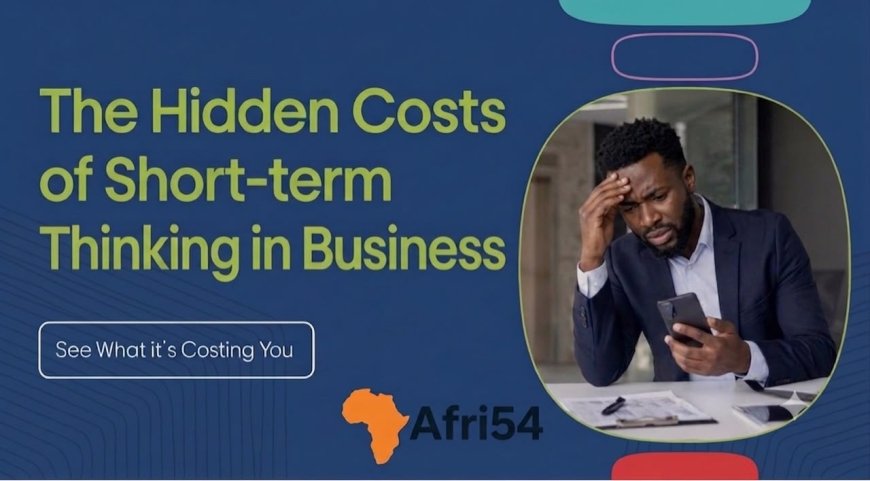


In boardrooms across the world, one question dominates strategic conversations: "How do we improve our numbers this quarter?" It is a reasonable question. Businesses exist to generate returns, satisfy customers, reward investors, and remain competitive in increasingly volatile markets. Yet beneath this relentless pursuit of immediate performance lies one of the most underestimated threats to sustainable business success—short-term thinking.
Short-term thinking, often referred to as corporate short-termism, is the tendency to prioritize immediate financial or operational gains at the expense of long-term value creation. While it may deliver encouraging quarterly reports or temporary spikes in profitability, it frequently erodes the very foundations upon which enduring businesses are built. Customer trust, employee commitment, innovation capacity, operational resilience, and brand reputation are all assets that compound over time. When sacrificed for immediate results, the damage is rarely visible in the present but becomes painfully evident in the future.
History offers countless examples of businesses that appeared financially strong just before entering periods of decline. Their balance sheets reflected growth, but beneath the surface, innovation had slowed, employee morale had weakened, customer confidence had diminished, and strategic vision had been replaced by tactical survival. The warning signs were present, but they remained hidden because conventional business metrics often reward what is immediately measurable while overlooking what is strategically valuable.
This challenge is particularly relevant within Africa's rapidly evolving business landscape. Across the continent, entrepreneurs are building ambitious ventures in environments shaped by economic uncertainty, inflationary pressures, currency fluctuations, regulatory shifts, and increasing competition. These realities naturally encourage business leaders to focus on immediate cash flow and operational survival. Yet the organizations that will define Africa's economic future are unlikely to be those that merely survive the next quarter; they will be those that deliberately build institutions capable of thriving over decades.
The distinction between companies that endure and those that disappear rarely lies in intelligence or ambition alone. More often, it lies in the quality of their time horizon.


The Rise of the Short-Term Business Mindset
Modern business has become increasingly obsessed with speed. Decisions are made faster, products are launched faster, marketing campaigns are expected to deliver immediate returns, and investors often demand continuous quarterly growth. Digital technology has only intensified this culture. Executives now have access to real-time dashboards displaying revenue figures, website traffic, customer acquisition costs, conversion rates, and engagement metrics updated by the minute.
While access to data has undoubtedly improved decision-making, it has also created an unintended consequence: businesses have become conditioned to value what can be measured immediately over what creates enduring competitive advantage.
This phenomenon extends beyond publicly listed corporations. Startups pursue rapid user acquisition to satisfy venture capital expectations. Small businesses chase viral marketing trends instead of developing sustainable customer relationships. Established firms reduce investments in research and development because innovation rarely produces instant financial returns. Across industries, long-term strategy increasingly competes with short-term performance metrics.
The irony is striking. Technology has given organizations unprecedented analytical capabilities, yet many have become less strategic in how they think about growth. Instead of asking what will make the business indispensable five years from now, leaders often ask what will improve this month's performance report.
Over time, this subtle shift changes the nature of decision-making itself. Organizations begin optimizing for immediate outcomes rather than lasting value. They become efficient at producing results that look impressive today but create vulnerabilities tomorrow.


Why Smart Leaders Still Fall Into the Trap
It would be simplistic to assume that short-term thinking results from poor leadership. In reality, many experienced executives recognize the importance of long-term strategy. The challenge is that the systems surrounding them frequently reward short-term performance.
Investors evaluate quarterly earnings. Performance bonuses are often tied to annual financial targets. Shareholders respond immediately to fluctuations in profitability. Marketing teams are judged by monthly campaign performance, while sales departments operate under aggressive revenue quotas. Under these conditions, leaders face constant pressure to prioritize decisions that generate visible results within limited reporting cycles.
Behavioral economics provides another explanation. Human beings naturally exhibit what psychologists describe as present bias—the tendency to place greater value on immediate rewards than future benefits. This cognitive bias influences individuals and organizations alike. Faced with the choice between investing heavily in employee development, technological infrastructure, or product innovation versus improving short-term profitability, immediate financial gains often appear more attractive because they are tangible and measurable.
Organizational culture can reinforce this tendency. Businesses that celebrate short-term victories while neglecting long-term strategic milestones inadvertently teach employees that immediate performance matters more than sustainable excellence. Over time, this shapes incentives, influences hiring decisions, and gradually transforms corporate priorities.
The result is not simply a collection of isolated decisions but an institutional mindset that becomes increasingly difficult to reverse.
The Cost That Never Appears on the Balance Sheet
One of the greatest dangers of short-term thinking is that its consequences rarely appear where executives expect them to. Financial statements record revenue, expenses, assets, and liabilities, but they cannot fully capture deteriorating customer trust, declining organizational learning, weakened culture, or lost innovation.
These invisible costs accumulate quietly.
Perhaps no asset illustrates this better than trust. Every successful business depends upon confidence—customers must trust products, employees must trust leadership, investors must trust governance, and partners must trust commitments. Yet trust is remarkably difficult to measure in financial reports. It grows gradually through consistent behavior and can disappear almost overnight.
Organizations pursuing immediate financial gains often compromise customer experience in subtle ways. They reduce product quality to lower production costs, overpromise in advertising campaigns, automate customer service without preserving human empathy, or prioritize aggressive sales tactics over genuine problem-solving. None of these decisions may significantly affect quarterly revenue. In fact, some may temporarily increase it.
However, customers rarely judge businesses based on isolated transactions. They judge them based on accumulated experiences. Once confidence begins to erode, recovery becomes significantly more expensive than prevention.
Brand reputation operates according to similar principles. Unlike machinery or inventory, reputation cannot be purchased outright. It represents years of consistent delivery, ethical conduct, and public confidence. Businesses that sacrifice integrity for immediate commercial advantage often discover that reputational damage extends far beyond the original incident. Negative perceptions spread rapidly in today's digitally connected marketplace, influencing purchasing decisions long after financial reports have recorded short-term gains.
Perhaps the most overlooked casualty of short-term thinking is innovation. Genuine innovation requires experimentation, patience, and the willingness to accept temporary uncertainty. New technologies, research initiatives, product development, and organizational transformation rarely produce immediate returns. Their value compounds over time.
Consequently, businesses focused exclusively on immediate profitability often reduce investments in precisely those activities that secure future competitiveness. While competitors quietly strengthen research capabilities, improve operational systems, and invest in emerging technologies, short-term-focused organizations become increasingly efficient at managing yesterday's business model.
The consequences are rarely immediate. They emerge gradually until disruption arrives, at which point adaptation becomes far more difficult.
When Growth Becomes an Illusion
Not every growing business is becoming stronger.
This distinction is frequently overlooked because modern business culture often equates revenue growth with organizational health. Yet growth can conceal structural weaknesses.
A company may report increasing sales while customer loyalty steadily declines. Profit margins may improve because employee training has been reduced or maintenance postponed. Marketing performance may appear exceptional because promotional spending has intensified, even as product differentiation weakens.
These forms of growth resemble constructing additional floors on a building while neglecting its foundation.
Eventually, external pressures expose internal weaknesses.
Economic downturns reveal fragile cash flow management. New competitors expose limited innovation. Talent shortages reveal neglected organizational culture. Market disruption exposes outdated systems.
Businesses built on durable foundations experience these challenges differently. Their resilience stems not from avoiding adversity but from investing consistently in capabilities that enable adaptation.
The distinction between temporary performance and sustainable strength often becomes visible only during periods of uncertainty.
The African Business Perspective
For African businesses, the tension between immediate survival and long-term strategy is particularly complex. Entrepreneurs across the continent operate within environments where inflation, fluctuating exchange rates, infrastructure gaps, regulatory uncertainty, and constrained access to finance are everyday realities. In such conditions, prioritizing cash flow is not simply a strategic preference—it is often essential for survival.
Yet this reality also creates a paradox. Businesses that become consumed by day-to-day survival frequently postpone the very investments that could improve their resilience. Digital transformation is delayed because the upfront cost feels prohibitive. Staff development is viewed as an expense rather than an investment. Systems are replaced with improvisation, and governance structures are neglected in favour of informal decision-making.
The consequences become apparent as businesses scale. Processes that worked for a team of five begin to fail with a workforce of fifty. Customer relationships become inconsistent because they depend on individual effort rather than institutional systems. Expansion into new markets exposes weaknesses that were previously hidden.
Across Africa, some of the continent's most respected companies have demonstrated that long-term thinking is possible even in challenging environments. Rather than competing solely on price, they have invested in customer trust, operational excellence, technology, local talent, and governance. These investments may not have produced the fastest short-term returns, but they created organizations capable of adapting to economic cycles, technological disruption, and changing consumer expectations.
For African entrepreneurs, the lesson is not that short-term financial discipline is unimportant. Rather, it is that survival should never become a substitute for strategy. Businesses that continually postpone long-term investment eventually discover that the future arrives whether they prepared for it or not.
Playing the Long Game
The companies that consistently outperform over decades share a common characteristic: they understand the difference between managing a business and building an institution.
Managing a business focuses on today's operations. Building an institution focuses on creating value that endures beyond current market conditions, leadership teams, or economic cycles.
This requires leaders to evaluate decisions through a broader lens. Instead of asking whether a decision will increase next quarter's profit, they ask whether it strengthens the organization's long-term competitive position. Instead of viewing employees merely as operational resources, they see them as creators of future capability. Instead of treating customers as transactions, they cultivate relationships built on trust and shared value.
Long-term thinking also demands patience—a quality increasingly rare in contemporary business culture. Sustainable brands are not built through isolated marketing campaigns but through years of consistent delivery. Strong organizational cultures emerge through repeated leadership behaviours rather than motivational slogans. Innovation flourishes where experimentation is encouraged despite uncertain outcomes.
None of these investments produce instant gratification. Their returns accumulate gradually, often becoming visible only after years of disciplined execution.
This is precisely why they create enduring competitive advantage.
Conclusion: Building Businesses That Outlive the Present
The greatest threat posed by short-term thinking is not that it produces poor decisions. Many short-term decisions are rational within the circumstances in which they are made. The real danger is that they gradually redefine what success looks like. Organizations become so focused on achieving immediate outcomes that they lose sight of the broader purpose of business itself: creating enduring value.
The companies that shape industries, influence societies, and survive generations are rarely those that mastered quarterly performance alone. They are the organizations that understood the power of compounding—compounding trust, capability, innovation, reputation, relationships, and institutional knowledge. These are assets that cannot be built overnight, but once established, they become extraordinarily difficult for competitors to replicate.
As Africa enters a new era of entrepreneurship, digital transformation, and economic integration, the continent's next generation of business leaders faces a defining choice. They can build companies designed to impress the next investor meeting, or they can build institutions designed to outlast economic cycles, technological shifts, and changes in leadership.
The future will undoubtedly reward agility, but agility without vision is merely reaction. Sustainable success belongs to businesses that can balance the urgency of today's demands with the discipline of tomorrow's ambitions.
In business, the most expensive decisions are often not the ones that fail immediately. They are the ones that succeed just enough in the short term to distract leaders from the long-term costs accumulating beneath the surface. The organizations that recognize this distinction—and choose to play the long game—will not simply grow. They will endure.