

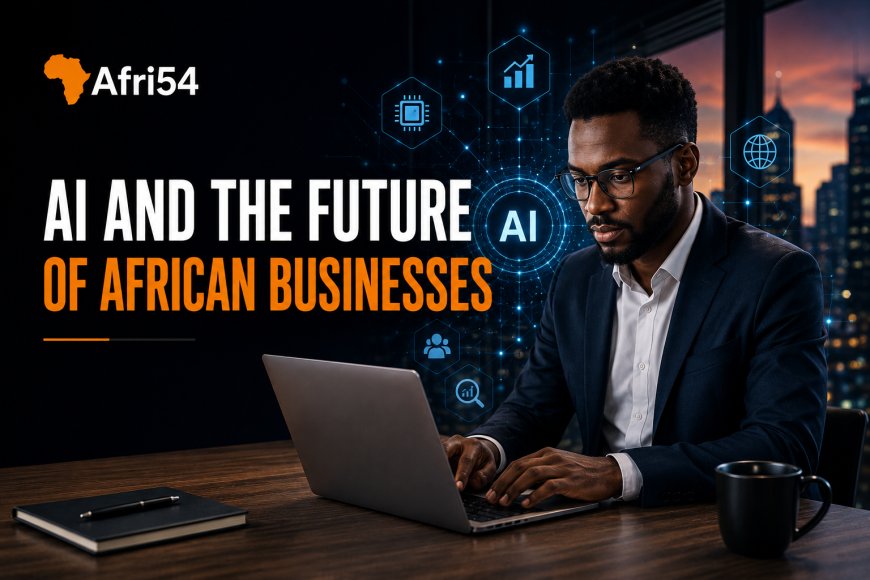
AI and the Future of African Businesses.
Artificial intelligence is no longer a technology waiting on the horizon. It is already reshaping the global economy, changing how businesses operate, compete, innovate, and make decisions. Across industries, companies are using AI to analyze vast amounts of data, automate routine processes, improve customer experiences, develop products, and identify opportunities with a speed and scale that were previously difficult to achieve.
 chijioke


Artificial intelligence is no longer a technology waiting on the horizon. It is already reshaping the global economy, changing how businesses operate, compete, innovate, and make decisions. Across industries, companies are using AI to analyse vast amounts of data, automate routine processes, improve customer experiences, develop products, and identify opportunities with a speed and scale that were previously difficult to achieve.
For businesses around the world, the conversation is therefore moving beyond whether artificial intelligence matters. The more pressing question is how quickly organisations can integrate it into their operations and, more importantly, how effectively they can turn it into a sustainable competitive advantage.
Africa is entering this transformation from a unique position.
Businesses across the continent operate in markets characterised by diverse languages and cultures, fragmented infrastructure, varying levels of digital maturity, limited access to capital, and a large informal economy. Yet these complexities exist alongside significant opportunities. Africa has one of the world's youngest populations, a rapidly expanding consumer market, a growing technology ecosystem, and a generation of entrepreneurs increasingly building businesses around digital innovation.
Artificial intelligence could become one of the most significant forces shaping what comes next.


However, the future of AI in Africa will not simply be determined by how quickly businesses adopt technologies developed elsewhere. A more important question is whether African companies can move beyond being consumers of AI to becoming active participants in building the products, systems, and businesses that will define the continent's digital economy.
That distinction matters because artificial intelligence has the potential to do more than improve the way African businesses operate. It could change the kinds of businesses that are built, the markets they can serve, and the problems they are capable of solving.
From AI Adoption to Business Transformation
The early conversation around artificial intelligence often focused on its ability to improve individual tasks. Businesses experimented with AI to generate content, summarise documents, conduct research, or automate repetitive administrative work. These applications remain valuable, but they represent only the beginning of what AI could mean for business.
The more significant opportunity lies in integrating artificial intelligence into the core of how companies operate.
For an African business, this could mean using data to understand customer behaviour more accurately, identifying inefficiencies across its operations, improving forecasting, automating internal workflows, or developing products that would have been too expensive or complex to build using traditional methods.


This shift is important because competitive advantage will not necessarily belong to the companies that use the most AI tools. It will belong to those that understand where AI can create meaningful economic value and integrate it into their business models with a clear purpose.
A company that uses AI to produce marketing copy may save time. Another company that uses AI to analyse customer behaviour, personalise its marketing, automate lead qualification, and improve its sales process is fundamentally changing how it acquires and retains customers. The difference is not the technology itself, but the strategic thinking behind its application.
African business leaders therefore need to move beyond the question of what AI can do and focus on what their businesses need to achieve. The real opportunity lies in identifying the areas where intelligence, automation, and data can improve productivity, reduce costs, strengthen decision-making, or create entirely new sources of revenue.
In this sense, AI is becoming less of a standalone technology and more of a layer that will increasingly sit across the modern business environment.
Africa's Opportunity Goes Beyond Adoption
Africa's technology story has often been described through the lens of adoption and digital inclusion. The continent has made remarkable progress in areas such as mobile money, fintech, e-commerce, and digital services, often finding innovative ways to overcome limitations in traditional infrastructure.
Artificial intelligence presents an opportunity to build on that history of innovation.
In some sectors, African businesses may be able to leapfrog traditional models and develop new systems that are designed for an AI-enabled economy from the beginning. Rather than simply digitising existing processes, companies can rethink how those processes should work in the first place.
This is particularly relevant in markets where conventional systems have historically struggled to meet the needs of large and diverse populations. Challenges around financial access, agricultural productivity, healthcare delivery, logistics, education, and commerce are significant, but they also represent areas where technology can create substantial value.
The opportunity for African entrepreneurs is therefore not simply to use AI to make existing businesses marginally more efficient. It is to identify problems that have remained difficult to solve and explore whether artificial intelligence can make new solutions possible.
That could lead to a new generation of African businesses built around intelligent financial services, data-driven agriculture, more efficient supply chains, personalised education, digital healthcare support, and technology that makes services more accessible to underserved communities.
The most important question, however, is whether these innovations will be built in Africa, for African markets, by companies that understand the continent's realities.
Building AI for African Realities
Artificial intelligence is often presented as a universal technology, but its effectiveness depends heavily on the data, languages, and environments in which it is developed and deployed.
This presents both a challenge and an opportunity for Africa.
The continent is home to thousands of languages and hundreds of millions of consumers with different cultural, economic, and social realities. A technology designed primarily around data from other parts of the world may not always perform effectively when applied to African contexts.
Language is one example. Many African languages remain significantly underrepresented in mainstream AI systems, creating limitations for people who do not primarily communicate in globally dominant languages. This is not simply a technological gap; it is also a business opportunity.
African technology companies and entrepreneurs have the potential to develop AI systems that understand local languages, cultural contexts, consumer behaviour, and business environments more effectively. Solutions built around these realities could serve African markets while also creating intellectual property with applications in other emerging markets.
The opportunity, therefore, is to build for Africa without limiting the ambition to Africa.
If African businesses can develop solutions that address local challenges at scale, some of those solutions may eventually become globally relevant. The continent's complexity could become an advantage rather than a limitation, particularly for companies capable of turning difficult local problems into scalable innovations.
Data Will Shape the AI Economy
The future of artificial intelligence will be closely tied to the quality and availability of data.
Across Africa, enormous amounts of information are being generated through financial transactions, mobile services, e-commerce, healthcare, agriculture, transportation, and consumer activity. Yet much of this data remains fragmented, poorly structured, or inaccessible to the businesses and researchers that could use it to create better products and services.
This presents a strategic challenge.
Without strong data infrastructure, businesses may struggle to build reliable AI systems. Without representative African datasets, technology developed for African markets may continue to reflect assumptions and patterns drawn primarily from other parts of the world.
The question of who controls and develops valuable data will therefore become increasingly important.
African businesses need to recognise that data is not merely an operational resource. It is a strategic asset. Companies that understand how to collect, protect, organise, and responsibly analyse data will be better positioned to compete in an AI-driven economy.
At the same time, African governments and institutions will need to create frameworks that encourage innovation while protecting individuals and businesses from the misuse of personal information.
The continent's AI future will depend, in part, on whether Africa can build the data ecosystems required to support its ambitions.
The Impact on African Jobs and Talent
Few issues surrounding artificial intelligence generate as much concern as its potential impact on employment.
For Africa, this conversation carries particular weight. The continent has a young and rapidly growing population, with millions of people expected to enter the workforce in the coming years. At the same time, many businesses are already operating under pressure to improve productivity and reduce costs.
AI will undoubtedly change the nature of work.
Some tasks that currently require significant amounts of human time will become automated, while other roles will evolve as employees begin working alongside intelligent systems. New opportunities are also likely to emerge in areas such as AI development, data analysis, cybersecurity, digital transformation, technology management, and AI governance.
The challenge is ensuring that Africa's workforce is prepared for this transition.
Businesses will need to invest in reskilling and continuous learning rather than treating AI adoption solely as an opportunity to reduce headcount. The most valuable employees in an AI-enabled workplace may increasingly be those who can combine technical understanding with creativity, critical thinking, communication, cultural intelligence, and sound judgement.
This is where African businesses have an important responsibility.
The AI transformation should not simply be about making companies more automated. It should also be about making people more capable.
If businesses and institutions can equip young Africans with the skills required to work with emerging technologies, AI could become a powerful tool for expanding economic opportunity. If they fail to do so, the gap between those who have access to digital skills and those who do not could become even wider.
The Risk of Becoming Consumers Rather Than Creators
There is a broader economic question that African businesses cannot afford to ignore.
Much of Africa's historical economic relationship with the global economy has involved exporting raw materials and importing higher-value finished products. The emergence of artificial intelligence creates an opportunity to avoid reproducing that pattern in the digital economy.
If African businesses rely entirely on foreign AI models, cloud infrastructure, data systems, and technology platforms, a significant share of the value created by the AI revolution could continue to flow outside the continent.
This does not mean Africa should develop every technology independently. Global collaboration and access to international technology will remain essential. But Africa must also build its own capacity.
That means supporting local AI startups, strengthening research institutions, investing in technical education, developing African datasets, and creating an environment where innovative companies can grow beyond individual national markets.
The goal should be to build an ecosystem in which African businesses can participate across the entire AI value chain—from research and infrastructure to product development, deployment, and commercialisation.
Africa needs more than businesses that know how to use AI.
It needs businesses capable of building with it.
Infrastructure Remains the Foundation
The promise of artificial intelligence cannot be separated from the realities of digital infrastructure.
AI requires reliable electricity, affordable internet access, computing capacity, secure digital systems, and skilled professionals. Where these foundations are weak, the ability of businesses to adopt and scale AI will remain limited.
This is one of the greatest challenges facing Africa's AI ambitions.
The continent's digital economy is developing unevenly. While major commercial centres have become increasingly connected and technologically sophisticated, many businesses and communities continue to face basic challenges around electricity, connectivity, affordability, and access to digital tools.
This creates a risk that the benefits of AI will become concentrated among large corporations and well-funded technology companies while smaller businesses are left behind.
For AI to contribute meaningfully to Africa's economic development, access must extend beyond a relatively small group of technology leaders. Governments, investors, telecommunications companies, financial institutions, and businesses will all have a role to play in expanding the infrastructure required for broader participation.
The objective should not simply be to create a handful of highly advanced AI companies. It should be to build an economy in which businesses of different sizes can use technology to become more productive and competitive.
Trust and Responsible AI Will Matter
As artificial intelligence becomes more deeply embedded in business, questions of trust will become increasingly important.
Businesses will have to consider how they collect and use customer data, how automated decisions are made, how bias is identified, and who remains accountable when an AI system produces an inaccurate or harmful outcome.
These questions are especially important in sectors such as financial services, healthcare, employment, and education, where automated decisions can have significant consequences for individuals.
African businesses therefore need to approach AI adoption with the same seriousness they would bring to any major transformation of their operations.
Responsible AI cannot be an afterthought. Data privacy, cybersecurity, transparency, human oversight, and accountability must be considered from the beginning.
Companies that ignore these issues may achieve short-term efficiency but risk losing the trust of customers and employees in the long term.
In an increasingly digital economy, trust itself will become a competitive advantage.
What the Future Requires From African Business Leaders
The AI era will require African business leaders to think differently about strategy.
The first step is not necessarily to invest in the most sophisticated technology available. It is to understand the business clearly enough to identify where AI can make a meaningful difference.
Leaders need to examine their operations, understand where inefficiencies exist, identify the data they already possess, and determine which capabilities their workforce will need in the future.
They must also consider how AI could change their industries over the next five to ten years.
A business that waits until competitors have already transformed their operations may find itself trying to catch up in an environment where the rules of competition have changed.
The organisations that are likely to benefit most will be those that begin experimenting early, learn from implementation, invest in their people, and gradually build AI into their broader business strategy.
The objective should not be to adopt AI for the sake of appearing innovative. It should be to use technology to build stronger, more resilient, and more competitive businesses.
Conclusion: Africa Must Shape Its Own AI Future
Artificial intelligence represents one of the most significant technological shifts of the modern era, and its impact on Africa will depend on choices being made today.
The continent has a genuine opportunity to use AI to improve productivity, strengthen businesses, expand access to essential services, and create entirely new industries. Its young population, growing technology ecosystem, and history of innovation provide a strong foundation for this next phase of digital transformation.
But opportunity alone is not enough.
Africa's future in the AI economy will depend on whether its businesses and institutions are willing to invest in the infrastructure, talent, data, research, and responsible governance required to turn potential into lasting economic value. It will also depend on whether African entrepreneurs are given the opportunity to build solutions that reflect the continent's realities rather than simply adapting technologies designed for other markets.
The greatest risk is not that Africa will fail to use artificial intelligence. The greater risk is that it will become dependent on an AI economy built elsewhere, consuming technologies without building the capacity to create, own, and shape them.
The next generation of African businesses must therefore think beyond adoption. They must think about innovation, ownership, and long-term competitiveness.
The opportunity before Africa is not simply to use AI to make existing businesses more efficient. It is to rethink how businesses are built, how markets are served, and how some of the continent's most persistent challenges can be transformed into opportunities for innovation.
The decisions African businesses make today will influence their ability to compete tomorrow. Those that invest in people, embrace responsible innovation, understand the strategic value of data, and build around the realities of their markets will be better positioned to thrive in the years ahead.
Artificial intelligence is already changing the global business landscape. For Africa, the moment is not simply about keeping pace with that change. It is about deciding what role the continent will play in shaping it.
The future of African business will be influenced by AI. The real question is whether Africa will merely participate in that future—or help build it.