

How OPay Went From Street Traders to a Billion-Dollar Super App: The Untold Nigerian Story
In the crowded streets of Lagos, where yellow buses weave through impossible traffic and roadside traders shout above the noise of generators, one sound quietly became part of daily Nigerian life:
 chijioke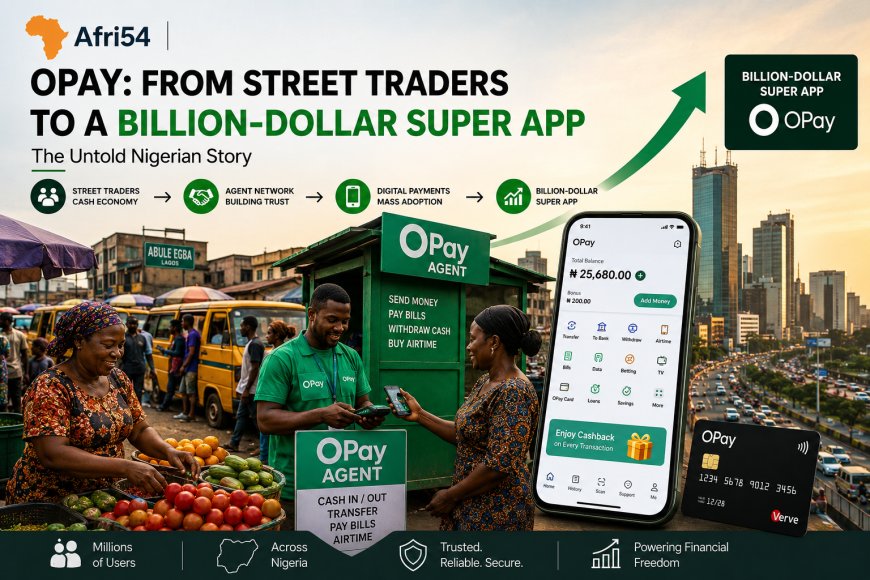


In the crowded streets of Lagos, where yellow buses weave through impossible traffic and roadside traders shout above the noise of generators, one sound quietly became part of daily Nigerian life: “Send am to my OPay.”
What began as a relatively unknown fintech experiment evolved into one of Africa’s most dominant financial technology platforms. Today, OPay processes millions of transactions daily, powers payments for small merchants, and has become deeply embedded in the rhythm of urban commerce across Nigeria. But the real story of OPay is not simply about technology or billion-dollar valuations. It is about understanding a country that global tech companies often misunderstood.
The rise of OPay reveals something larger about Nigeria itself: innovation in Africa succeeds not when it imitates Silicon Valley, but when it solves African problems with African realities in mind.
The Nigeria Most Banks Ignored
Before fintech became fashionable, millions of Nigerians operated almost entirely outside formal banking systems. In major cities and rural communities alike, cash ruled everything.
Street traders, bus drivers, food vendors, market women, and small shop owners faced the same frustrations daily: unreliable bank networks, endless ATM queues, failed transfers, and high banking barriers. Traditional financial institutions largely focused on salaried workers and middle-class customers while informal traders, despite driving enormous economic activity — remained underserved.


Nigeria was a paradox. It had one of Africa’s largest economies and one of the continent’s most entrepreneurial populations, yet financial access remained painfully uneven.
This gap created fertile ground for disruption.
When smartphones became cheaper and mobile internet spread rapidly across urban Nigeria, a new generation of fintech companies saw opportunity. But many early players approached the market from a purely digital perspective. OPay did something different.
It went to the streets.
A Chinese-Backed Startup With an Unusual Strategy
OPay launched in Nigeria in 2018 under Opera, the Norwegian browser company with strong Chinese investment backing through Kunlun Tech. At first glance, many Nigerians viewed it as just another foreign tech platform entering Africa with ambitious promises.


But OPay’s leadership quickly realized something essential: Nigeria’s biggest financial opportunity was not online commerce alone. It was offline commerce.
Rather than targeting elite consumers first, the company aggressively pursued the informal economy, the everyday traders and small businesses powering Nigerian cities.
This was unconventional.
At the time, many startups were obsessed with app downloads, sleek branding, and affluent users. OPay instead focused on visibility in crowded neighborhoods, open markets, roadside kiosks, and transport hubs. The company deployed thousands of physical agents wearing green branding across cities like Lagos, Ibadan, Aba, Kano, and Port Harcourt.
These agents became human ATMs for communities underserved by banks.
Suddenly, people no longer needed to travel long distances to withdraw cash or complete transfers. A nearby OPay agent could handle it within minutes.
The strategy worked because it acknowledged a simple truth: in Nigeria, trust is often physical before it becomes digital.
The Street Agent Revolution
Perhaps the most overlooked part of OPay’s success is its agent network.
The average Nigerian trader did not initially care about fintech innovation or digital banking terminology. What mattered was convenience, speed, and reliability.
OPay’s agents offered exactly that.
Small kiosks branded in bright green began appearing everywhere. They processed transfers, cash withdrawals, airtime purchases, utility payments, and deposits. For many neighborhoods, especially those with weak banking infrastructure, these agents effectively became mini-banks.
But the deeper genius of the model was economic.
OPay turned ordinary Nigerians into entrepreneurs within its ecosystem. Thousands of young people suddenly had income opportunities as agents. Small shops increased customer traffic. Informal workers found a business model requiring relatively low startup capital.
In many ways, OPay did not merely build an app. It built a distributed commercial network.
The company understood something many outsiders missed: Nigeria’s economy is intensely social. Adoption spreads through human interaction faster than advertising campaigns.
When traders saw neighboring businesses using OPay successfully, skepticism began fading.
Betting Big While Others Hesitated
OPay’s expansion was extraordinarily aggressive.
The company reportedly spent heavily on customer acquisition, discounts, transfer incentives, and branding. Free transfers and cashback offers flooded the market. Green OPay signs became nearly unavoidable in major cities.
Critics questioned whether the company was burning money too quickly.
But OPay appeared to be playing a long-term infrastructure game rather than chasing short-term profitability. The goal was scale, habit formation, and market dominance.
That ambition attracted investors.
In 2021, OPay raised a massive funding round reportedly exceeding $400 million, pushing its valuation beyond $2 billion and placing it among Africa’s fintech unicorns. Investors saw enormous potential in Nigeria’s rapidly growing digital payments economy.
Yet the valuation alone does not explain OPay’s significance.
What mattered more was behavioral change.
Millions of Nigerians who once depended almost entirely on cash transactions had begun integrating digital finance into daily life — often through OPay.
Why Nigerians Embraced OPay So Quickly
Many fintech companies offer similar services on paper: transfers, bill payments, debit cards, and mobile wallets. But products do not succeed in Nigeria merely because they exist.
They succeed when they fit Nigerian behavior.
OPay succeeded partly because it reduced friction in everyday survival. Transfers were often faster. Agent locations were widespread. The app interface felt accessible to ordinary users, not just tech-savvy professionals.
The company also mastered localization.
Its marketing campaigns felt distinctly Nigerian. It expanded beyond elite business districts into densely populated commercial areas. Instead of waiting for users to adapt to fintech culture, OPay adapted to Nigerian culture.
That distinction changed everything.
For lower-income users and small traders, reliability mattered more than sophistication. OPay positioned itself as practical rather than aspirational.
It became less of a luxury tech product and more of a utility.
Competition, Regulation, and Survival
OPay’s rise did not happen without resistance.
Nigeria’s fintech ecosystem became intensely competitive, with companies like PalmPay, Moniepoint, Kuda Bank, and Flutterwave all battling for market share in different ways.
At the same time, regulators began paying closer attention to digital finance. Concerns around compliance, fraud prevention, customer protection, and financial security intensified as fintech adoption accelerated.
Nigeria’s regulatory environment can shift rapidly, and surviving it requires adaptability.
OPay managed to endure partly because it had already achieved something difficult to replicate: mass-market penetration.
The company was no longer just a startup. It had become infrastructure for millions of users.
That scale created resilience.
The Bigger African Lesson
The untold story of OPay is not simply that it became a billion-dollar company.
The deeper story is that it challenged old assumptions about African consumers.
For years, many international businesses viewed African markets through narrow lenses — assuming low-income populations could not support large-scale digital ecosystems. OPay demonstrated the opposite.
Nigeria’s informal economy, often dismissed as chaotic or fragmented, turned out to be one of the greatest fintech opportunities in the world.
The company succeeded because it understood that Africa’s next technological leap would likely happen differently from Europe or America. In Nigeria, digital adoption does not always begin with laptops, credit cards, or formal retail systems.
Sometimes it begins with a roadside kiosk, a market trader, and a smartphone transfer worth a few thousand naira.
Beyond the Billion-Dollar Headlines
Today, OPay stands as one of the most influential fintech brands in Africa. But its real achievement is not valuation headlines or investor excitement.
Its true achievement lies in normalization.
Digital payments are no longer viewed as elite tools in many Nigerian communities. They have become part of everyday life — woven into transport fares, food sales, neighborhood shops, and informal trade networks.
That transformation matters because financial access shapes economic mobility.
When small traders can move money faster, save more securely, receive payments easily, and operate with fewer barriers, local economies become more efficient. Millions of tiny financial improvements begin compounding across society.
OPay did not create Nigeria’s entrepreneurial spirit. That spirit existed long before the company arrived.
What OPay did was build infrastructure around it.
And in doing so, it told one of the most important business stories in modern Africa: sometimes the path to building a billion-dollar tech company does not begin in boardrooms or luxury districts.
Sometimes it begins on the street corner.