

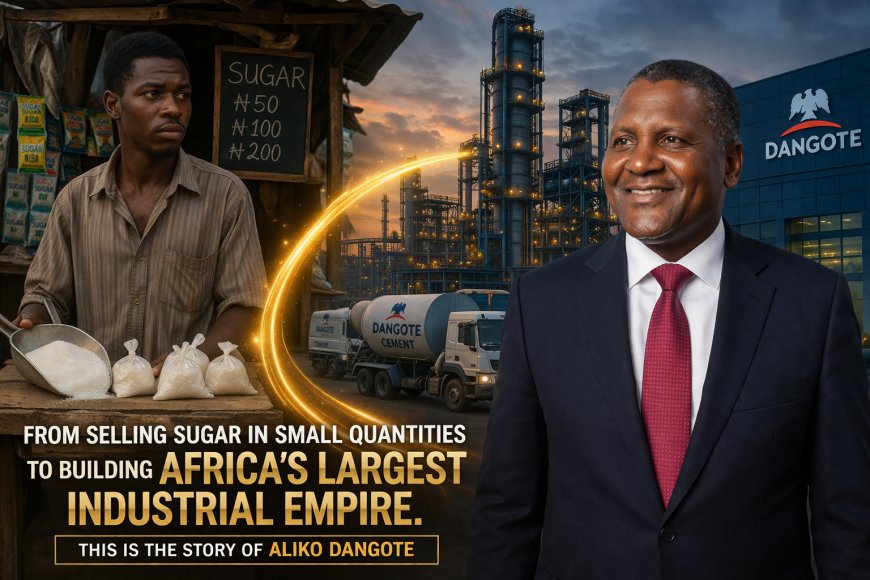
From selling sugar in small quantities to building Africa's largest industrial empire. ( This is the story of Aliko Dangote)
Long before the refineries, before the cement plants stretching across borders, before becoming the face of African industrial ambition, Aliko Dangote was doing something far less remarkable on the surface. He was moving sugar in small quantities, negotiating deals, learning how money actually behaves when it meets friction.
 chijioke


There’s a version of success people like to believe in. It looks clean in hindsight—linear, inevitable, almost scripted. But reality is rarely that cooperative.
Long before the refineries, before the cement plants stretching across borders, before becoming the face of African industrial ambition, Aliko Dangote was doing something far less remarkable on the surface. He was moving sugar in small quantities, negotiating deals, learning how money actually behaves when it meets friction.
There were no spotlights then. No certainty. Just margins, movement, and risk.
What’s easy to miss is that this phase wasn’t small in the way people think. It was foundational. While others might have seen trading as an end in itself, he treated it differently. Every transaction carried information. Every delay, every price shift, every dependency on imports revealed something about how the system worked—and more importantly, where it didn’t.
He wasn’t just selling goods. He was quietly studying a pattern that repeated itself across industries: demand was constant, but control was not.


That realization changes how you think.
Because once you see that clearly enough, trading starts to feel like a ceiling. You can move products, but you’re still exposed—to suppliers you don’t control, to policies you didn’t design, to fluctuations you can’t predict. You’re participating, not defining.
Most people stay there. It’s familiar. It pays. It feels safe enough. He didn’t.
At some point, the more uncomfortable question emerges: why keep importing what people consume every day? Why operate at the mercy of a system when you could attempt to build part of it?
That shift from moving goods to producing them, is where the story stops being ordinary.


It wasn’t a smooth transition. Building manufacturing capacity in an environment where infrastructure is inconsistent and costs are high is not an obvious move. It requires a level of commitment that goes beyond ambition. You’re no longer reacting to the market; you’re betting that you can shape it.
And that’s exactly what happened.
By moving into cement production, and later expanding into sugar, flour, and other essentials, he wasn’t diversifying for the sake of growth. He was tightening control. Each step reduced dependence on external systems and increased his ability to operate on his own terms.
That’s the part people simplify when they tell this story. They talk about scale as if it’s just about getting bigger. It’s not. Scale, in this context, is leverage. It’s the ability to produce at a level where costs shift in your favor, where competition struggles to keep up, where your presence starts to define the market itself.
But scale without direction is just noise. What made it effective was where it was applied.
While many businesses look outward for validation, chasing foreign markets or trends, his focus remained anchored in something less glamorous but far more powerful: essential demand within Africa. Not what was exciting, but what was necessary. Not what sounded innovative, but what people couldn’t do without.
That kind of focus forces a different discipline. You don’t get distracted easily because the problem in front of you is too real to ignore.
Over time, that discipline compounds. Production links to distribution. Distribution tightens into control. Control creates resilience in environments that are anything but stable. What starts as a business gradually becomes something more structural—a system that other parts of the economy begin to depend on.
By the time the Dangote Group became synonymous with industrial scale, the logic behind it had already been tested repeatedly in smaller, less visible decisions. There was no single moment where everything changed. Just a series of moves that, taken together, made it harder and harder to compete from the outside.
And yet, when people look at outcomes like this, they tend to reach for simple explanations. They reduce it to ideas, or timing, or luck—anything that makes it feel easier to replicate without requiring the same level of commitment.
But this story resists that kind of simplification.
Because there’s nothing particularly novel about trading sugar or producing cement. The difference is not in the idea. It’s in the depth of execution and the willingness to stay long enough to understand the game you’re playing.
That’s where most people fall short.
There’s a constant temptation to move on too quickly, to chase something new before fully exhausting what’s in front of you. It feels like progress, but it often isn’t. It’s movement without accumulation. Activity without control.
What this path shows—if you’re willing to look closely—is that real leverage comes from staying. From pushing past the point where things are still surface-level and into the part where patterns become clear and decisions start to compound.
That’s not exciting. It doesn’t give you quick validation. But it builds something that lasts.
Which brings the story back to where it becomes uncomfortable.
It’s easy to admire what Aliko Dangote has built. It’s harder to confront what it demands. Not in theory, but in practice.
Not what you say you want to build. Not what you’re planning.
What are you actually building right now?
Something you’ve stayed with long enough to begin understanding its edges. Something that forces you to deal with constraints instead of avoiding them. Something that, over time, could move you from participating in a system to shaping even a small part of it.
Because the distance between small beginnings and massive outcomes isn’t as mysterious as it looks. It’s direction, held long enough to compound.
Most people never give anything that kind of time.
So the question isn’t whether it’s possible. That part is already answered.
The question is whether you’re doing anything today that would make that kind of outcome even remotely inevitable—or whether you’re still moving from one idea to the next, mistaking motion for progress.
That’s not a comfortable question.
But it’s the only one that matters.