

Abu Simbel: Where Pharaoh’s Power Meets Celestial Precision
Explore the colossal Abu Simbel Temples in Egypt, built by Pharaoh Ramses II in the 13th century BCE. Discover the solar alignment miracle, the dedication to Queen Nefertari, and the incredible UNESCO-led rescue mission that saved this ancient rock-cut masterpiece from the waters of the Aswan Dam. A must-see Egyptian wonder.
 Afri54
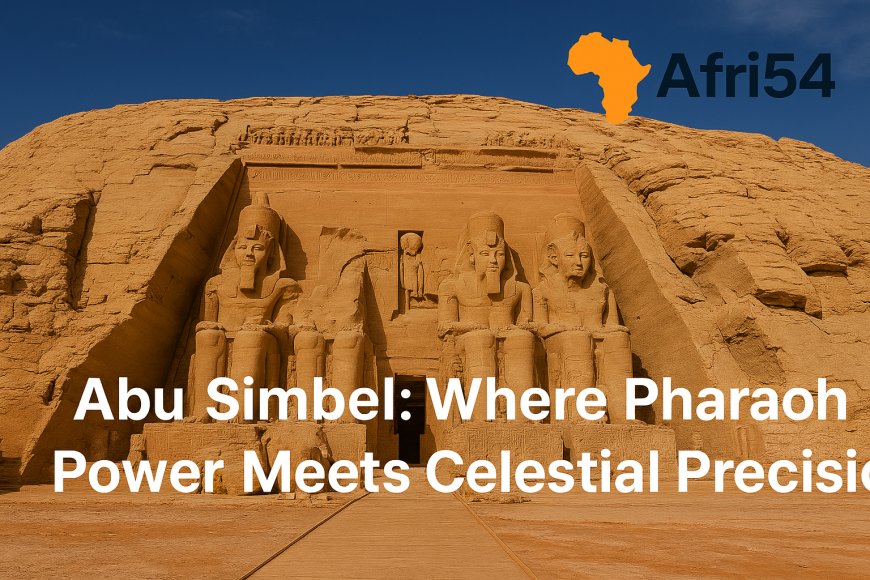


The history of ancient Egypt is a story told in stone, but few monuments speak with the thunderous voice and sheer ambition of the Abu Simbel Temples. Carved directly into a sandstone cliff in what was once Nubia, these two monumental rock-cut temples—commissioned by the mighty Pharaoh Ramses II (Ramesses the Great) in the 13th century BCE—are a breathtaking testament to his power, piety, and enduring love.
Located in Egypt's deep south, overlooking the majestic Lake Nasser, Abu Simbel is more than an archaeological site; it is a marvel of ancient engineering and a stage for an extraordinary modern rescue mission.
The Vision of Ramses the Great
Ramses II, who ruled Egypt for an astounding 66 years (c. 1279–1213 BCE), was a prolific builder. He ordered the construction of the Abu Simbel complex to serve two primary purposes: to solidify his divine status and to project Egyptian might over the newly conquered territory of Nubia. The temples took approximately 20 years to complete, from about 1264 BCE to 1244 BCE.


The Great Temple of Ramses II
The larger and more famous of the two structures, the Great Temple, is an astonishing spectacle.
-
Colossal Façade: Four colossal, seated statues of Ramses II—each over 20 meters (65 feet) tall—dominate the entrance. These monumental figures, carved straight from the mountainside, were designed to intimidate and impress, leaving no doubt about the pharaoh's greatness.
-
A Dedication to the Gods: The temple was dedicated to the great state gods Amun-Ra, Ra-Horakhty, and Ptah, as well as to the deified Ramses II himself.
-
The Hall of Pillars and Murals: Inside, the great hypostyle hall features eight more colossal statues of Ramses II in the form of the god Osiris. The inner walls are richly decorated with reliefs depicting Ramses' military triumphs, most notably his famous victory at the Battle of Kadesh.



The Smaller Temple of Nefertari
Right beside the main temple stands a smaller, yet equally significant, rock-cut temple dedicated to the goddess Hathor and Ramses' beloved principal wife, Queen Nefertari. It is a rare honor for a royal wife to receive such a grand, dedicated monument. Unusually, the statues of Nefertari on the façade are almost the same size as those of the pharaoh, a profound testament to Ramses II's devotion to his queen.
The Celestial Secret: Solar Alignment
Perhaps the most miraculous feature of the Great Temple is its astronomical precision. The entire structure was oriented so that on two days of the year—around February 22nd and October 22nd (one day later than the original dates due to the modern relocation)—the rising sun’s rays penetrate the temple’s inner sanctum, illuminating three of the four seated statues: Ramses II, Amun-Ra, and Ra-Horakhty.
Only the statue of Ptah, the god associated with the underworld and darkness, remains perpetually in shadow. These two dates are widely believed to correspond to Ramses II’s coronation day and his birthday, linking his divine rule directly to the cosmic order and the sun's power. This spectacular event is now celebrated as the Abu Simbel Sun Festival, drawing crowds from across the globe.
An Epic Rescue: Saving a World Treasure
The temples of Abu Simbel nearly vanished beneath the waves of history. In the 1960s, the construction of the massive Aswan High Dam threatened to submerge the entire complex under the rising waters of the newly formed Lake Nasser.
What followed was an unprecedented international effort led by UNESCO. Between 1964 and 1968, a consortium of engineers, archaeologists, and workers executed one of the greatest feats of modern civil engineering:
-
Dismantling: The two temples were meticulously cut into over 1,000 gigantic blocks, some weighing up to 30 tons.
-
Relocation: The blocks were carefully transported to a new site—an artificial hill 65 meters (213 feet) higher and 200 meters (656 feet) further inland than the original location.
-
Reconstruction: The temples were then painstakingly reassembled with incredible precision, ensuring their structural integrity and, remarkably, preserving their original, famous solar alignment.
This $40 million (in 1960s value) rescue operation was a triumph of global cooperation, cementing Abu Simbel's status not just as an ancient wonder, but as a symbol of humanity's commitment to preserving its shared heritage. The complex was inscribed as a UNESCO World Heritage Site in 1979.
Planning Your Visit
A journey to Abu Simbel, typically undertaken as a day trip from Aswan by air or via a police-escorted road convoy, is an unforgettable experience. Standing before the colossal statues of Ramses II and then walking the length of the temple to witness the inner sanctum is a humbling encounter with the ambition of a long-dead pharaoh.
Abu Simbel stands as a monumental legacy—a double triumph that celebrates the genius of ancient Egyptian architects and the extraordinary power of modern preservation.
Have you listed your business on Afri54?
Afri54 exists to solve a fundamental challenge faced by millions of African businesses: lack of visibility. Whether you're a craft seller in Lomé, a tour guide in Kpalimé, or a hotel owner in Kara, you deserve to be seen.
👉 Join now